
Graded Cards
Pokémon Card Rarity Symbols Explained: A Complete Guide (2026)
Aug
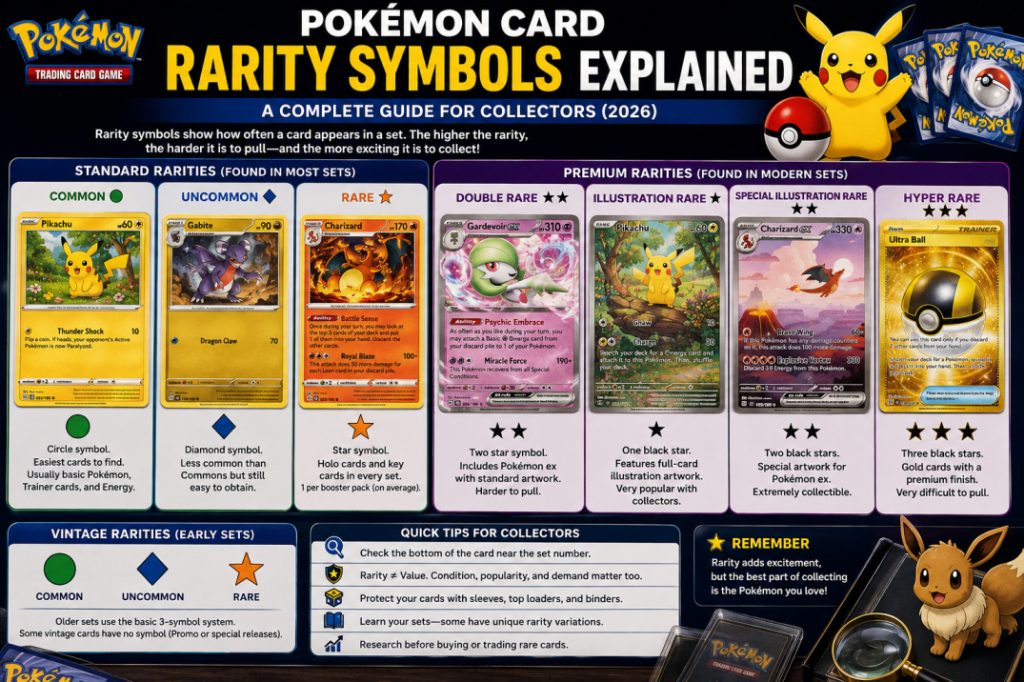
Understanding Pokémon card rarity symbols is one of the first skills every collector should learn. Whether you’re opening your first booster pack or organizing a growing collection, rarity symbols help identify how common or difficult a card is to obtain. While rarity doesn’t always determine a card’s value, it plays a major role in how collectors evaluate cards and build their collections. Learning Pokémon card rarity symbols will help you recognize valuable pulls, understand different card types, and make more informed collecting decisions.
Over the years, the Pokémon Trading Card Game has introduced several rarity systems. Early expansions used a simple approach with common, uncommon, and rare cards, while modern sets include Illustration Rares, Special Illustration Rares, Hyper Rares, Double Rares, and other premium card types. Although the system has evolved, knowing how to identify rarity remains essential for collectors of every experience level.
This guide explains where to find rarity symbols, what each rarity means, and how they influence collecting in 2026.
Why Pokémon Card Rarity Symbols Matter
Every Pokémon card tells a story, and the rarity symbol is one of the quickest ways to understand how frequently that card appears within its expansion.
Rarity symbols help collectors:
- Organize collections
- Complete master sets
- Identify premium cards
- Understand pull rates
- Recognize collectible cards
- Research card values more efficiently
Without understanding rarity, it becomes much harder to evaluate a Pokémon collection accurately.
Where to Find Pokémon Card Rarity Symbols
One of the first things new collectors ask is where rarity symbols are located.
On most modern Pokémon cards, you’ll find the rarity indicator near the bottom of the card, close to:
- Card number
- Expansion information
- Set code
Although the exact layout varies slightly between expansions, the rarity symbol is generally easy to locate once you know where to look.
Learning to identify it quickly becomes second nature after opening a few booster packs.
The Original Pokémon Card Rarity System
When the Pokémon Trading Card Game was first released, rarity was simple.
Most cards fell into one of three categories.
Common (●)
The circle symbol represents a Common card.
Common cards are the easiest cards to find within booster packs.
Examples often include:
- Basic Pokémon
- Trainer cards
- Energy cards
- Early-stage Pokémon
Although common cards are widely available, many remain important for gameplay and set completion.
Uncommon (◆)
The diamond symbol represents an Uncommon card.
These cards appear less frequently than Commons but remain relatively easy to obtain.
Uncommon cards often include:
- Stage 1 Pokémon
- Strong Trainer cards
- Useful gameplay support cards
Many competitive decks include numerous Uncommon cards because of their useful abilities.
Rare (★)
The star symbol identifies a Rare card.
Rare cards generally appear once per booster pack in traditional Pokémon expansions.
Depending on the set, Rare cards may include:
- Holographic cards
- Non-holographic rares
- Pokémon ex
- Powerful evolved Pokémon
For many new collectors, pulling a Rare card remains one of the most exciting moments when opening packs.
Modern Pokémon Card Rarity Levels
As the Pokémon Trading Card Game evolved, new rarity categories were introduced.
These modern rarities feature premium artwork, textured finishes, and lower pull rates.
Double Rare
Double Rare cards usually include Pokémon ex with standard artwork.
Characteristics include:
- Competitive Pokémon
- Glossy finish
- Strong gameplay appeal
- Moderate pull rates
These cards serve as an important starting point for many collectors entering premium rarities.
Illustration Rare
Illustration Rare cards have become some of the most popular modern Pokémon cards.
Instead of focusing only on battle scenes, these cards feature beautiful artwork that tells a story.
Collectors appreciate Illustration Rares because of their:
- Full-card artwork
- Creative illustrations
- Artistic appeal
- Strong collector demand
Many Illustration Rare cards become collector favorites shortly after release.
Special Illustration Rare
Special Illustration Rare cards represent another premium rarity level.
These cards typically feature:
- Pokémon ex
- Full-art scenic illustrations
- Highly detailed artwork
- Lower pull rates
Collectors often consider Special Illustration Rare cards among the highlights of every modern Pokémon expansion.
Hyper Rare
Hyper Rare cards are easily recognized by their brilliant gold appearance.
They frequently feature:
- Gold backgrounds
- Premium finishes
- Limited pull rates
- Strong display appeal
Because of their striking design, Hyper Rare cards remain highly collectible.
Does Higher Rarity Always Mean Higher Value?
One of the biggest misconceptions among new collectors is that the rarest card is automatically the most valuable.
The reality is more complicated.
Value depends on several factors working together.
These include:
- Rarity
- Condition
- Popularity
- Artwork
- Collector demand
- Professional grading
For example, a Rare Charizard card may attract more collector attention than a rarer Pokémon featuring a less popular character.
Understanding this relationship helps collectors make smarter purchasing decisions.
Vintage vs. Modern Rarity Systems
Collectors often notice that vintage Pokémon cards look different from modern releases.
That’s because the rarity system has evolved over time.
Vintage Expansions
Early Pokémon sets primarily used:
- Common
- Uncommon
- Rare
The simplicity of this system makes vintage cards relatively easy to identify.
Modern Expansions
Today’s Pokémon expansions include a much broader range of rarity levels.
Collectors may encounter:
- Double Rare
- Illustration Rare
- Special Illustration Rare
- Hyper Rare
- Promotional cards
- Secret-style premium cards
These additional categories create greater variety and excitement during pack openings.
Which Rarity Levels Do Collectors Prefer?
Although every collector has personal preferences, several rarity categories consistently attract strong interest.
Among the most popular are:
- Illustration Rare
- Special Illustration Rare
- Hyper Rare
- Vintage Holographic Rare cards
- Limited promotional cards
These cards often combine beautiful artwork with lower pull rates, making them desirable additions to many collections.
How Rarity Affects Collectibility
One of the biggest reasons collectors pay attention to Pokémon card rarity symbols is because rarity often influences how desirable a card becomes over time.
However, rarity is only one part of the equation.
Collectors also consider:
- Card condition
- Artwork
- Featured Pokémon
- Expansion popularity
- Historical significance
- Professional grading
- Current collector demand
A card with a lower rarity can sometimes become more collectible than a higher-rarity card if it features an iconic Pokémon or memorable artwork.
For example, Charizard, Pikachu, Umbreon, and Rayquaza cards often attract strong collector interest regardless of their rarity level.
Understanding Pull Rates
Although Pokémon does not officially publish pull rates for booster packs, collectors generally recognize that premium rarities appear less frequently than Common, Uncommon, or standard Rare cards.
As rarity increases, collectors usually expect cards to become more difficult to obtain.
Because pull rates vary between expansions, some Illustration Rare or Special Illustration Rare cards become much harder to find than others.
This scarcity contributes to their popularity within the collecting community.
Promotional Cards and Their Rarity
Not every collectible Pokémon card comes from a booster pack.
Promotional cards are often distributed through:
- Special product collections
- Pokémon Center promotions
- Championship events
- Retail campaigns
- Anniversary celebrations
Many promotional cards do not follow the standard rarity system, yet they remain highly collectible because of their limited distribution and exclusive artwork.
Some promotional releases have become among the most desirable Pokémon cards ever produced.
Common Mistakes Beginners Make
Learning Pokémon card rarity symbols takes practice.
Many new collectors make similar mistakes during their first few months in the hobby.
Assuming Every Star Symbol Means High Value
A star simply indicates that a card is classified as Rare.
Its market value still depends on:
- Condition
- Popularity
- Collector demand
- Expansion
- Artwork
Some Rare cards remain affordable, while others become highly sought after.
Ignoring Card Condition
Even a premium rarity may lose collector appeal if it shows:
- Scratches
- Bent corners
- Whitening
- Surface damage
- Water damage
Protecting your cards from the beginning helps preserve both their appearance and long-term collectibility.
Confusing Rarity with Age
Older cards are not automatically rarer than newer ones.
Likewise, some modern premium rarities are considerably more difficult to obtain than certain vintage cards.
Always evaluate rarity based on the individual card rather than its release date alone.
Overlooking Promotional Cards
Many beginners focus exclusively on booster pack cards.
However, some promotional releases have become among the most collectible Pokémon cards in the hobby.
Learning how promotional cards are distributed helps collectors identify unique additions to their collections.
Tips for Identifying Pokémon Card Rarity
As your collection grows, identifying rarity becomes much easier.
Here are a few practical habits that experienced collectors recommend.
Check the Bottom of Every Card
The rarity symbol is usually located near the card number and set information.
Developing the habit of checking this area first saves time when sorting cards.
Learn Expansion Differences
Each Pokémon expansion introduces its own artwork and premium card selections.
Familiarity with different sets helps collectors recognize valuable cards more quickly.
Compare Similar Cards
If you’re unsure about a card’s rarity, compare it with other cards from the same expansion.
Differences in finish, artwork, and rarity classification often become easier to recognize when viewed side by side.
Keep Cards Organized
Many collectors organize their collections by:
- Expansion
- Card number
- Rarity
- Favorite Pokémon
- Release year
An organized collection makes identifying missing cards much easier.
Does Professional Grading Affect Rarity?
This is a common question among collectors.
The answer is no.
Professional grading authenticates a card and evaluates its condition, but it does not change how rare the card is.
A professionally graded Common card remains Common.
Likewise, an ungraded Special Illustration Rare remains a premium rarity.
Grading and rarity are two separate characteristics, although together they can significantly influence collector interest.
Expert Tips for New Collectors
If you’re just beginning your Pokémon collecting journey, these recommendations can help you better understand rarity.
- Learn the basic rarity symbols first.
- Become familiar with modern premium rarities.
- Protect valuable cards immediately.
- Focus on collecting Pokémon you genuinely enjoy.
- Research new expansions before opening packs.
- Handle cards carefully to preserve their condition.
Building knowledge gradually is often more rewarding than chasing only the rarest cards.
Final Thoughts
Understanding Pokémon card rarity symbols is one of the most valuable skills any collector can develop. From the original Common, Uncommon, and Rare classifications to today’s Illustration Rare, Special Illustration Rare, Double Rare, and Hyper Rare cards, the Pokémon Trading Card Game has created a rarity system that adds excitement to every booster pack and helps collectors appreciate the uniqueness of each card.
While rarity plays an important role in collectibility, it’s only one piece of the puzzle. Artwork, condition, popularity, grading, and collector demand all contribute to a card’s appeal. By learning how rarity symbols work and combining that knowledge with proper card care and research, you’ll be better equipped to recognize standout cards and build a collection you’ll enjoy for years to come.
Whether you’re opening your very first pack or adding another premium card to an established collection, understanding rarity will make every new discovery even more rewarding.
Frequently Asked Questions
1. What do Pokémon card rarity symbols mean?
Pokémon card rarity symbols indicate how commonly a card appears within an expansion. Common cards use a circle, Uncommon cards use a diamond, and Rare cards use a star, while modern sets also include premium rarity categories.
2. Where is the rarity symbol located on a Pokémon card?
The rarity symbol is usually found near the bottom of the card, close to the card number and expansion information.
3. What is the rarest Pokémon card rarity today?
Modern expansions include premium rarities such as Special Illustration Rare and Hyper Rare, although promotional and tournament-exclusive cards can be even rarer because of their limited distribution.
4. Does a higher rarity always mean a card is more valuable?
No. Value also depends on condition, artwork, popularity, collector demand, and professional grading.
5. What is an Illustration Rare Pokémon card?
An Illustration Rare card features full-card artwork that emphasizes storytelling and artistic design rather than traditional battle scenes.
6. What is a Hyper Rare Pokémon card?
Hyper Rare cards are premium gold-finished cards with distinctive artwork and relatively low pull rates.
7. Are promotional Pokémon cards considered rare?
Many promotional cards are highly collectible because they are distributed through special events, product collections, or limited campaigns rather than regular booster packs.
8. Does grading change a card’s rarity?
No. Professional grading authenticates and protects a card but does not affect its rarity classification.
9. Why are some Common cards still collectible?
Cards featuring popular Pokémon, memorable artwork, or historical importance may attract collector interest even if they have a Common rarity.
10. Why should collectors learn Pokémon card rarity symbols?
Understanding rarity symbols helps collectors identify cards, organize collections, evaluate booster pack pulls, and make informed collecting decisions.
