
Pokémon Card Guides
How to Tell if Pokémon Cards Are Real or Fake: The Complete Collector’s Guide (2026)
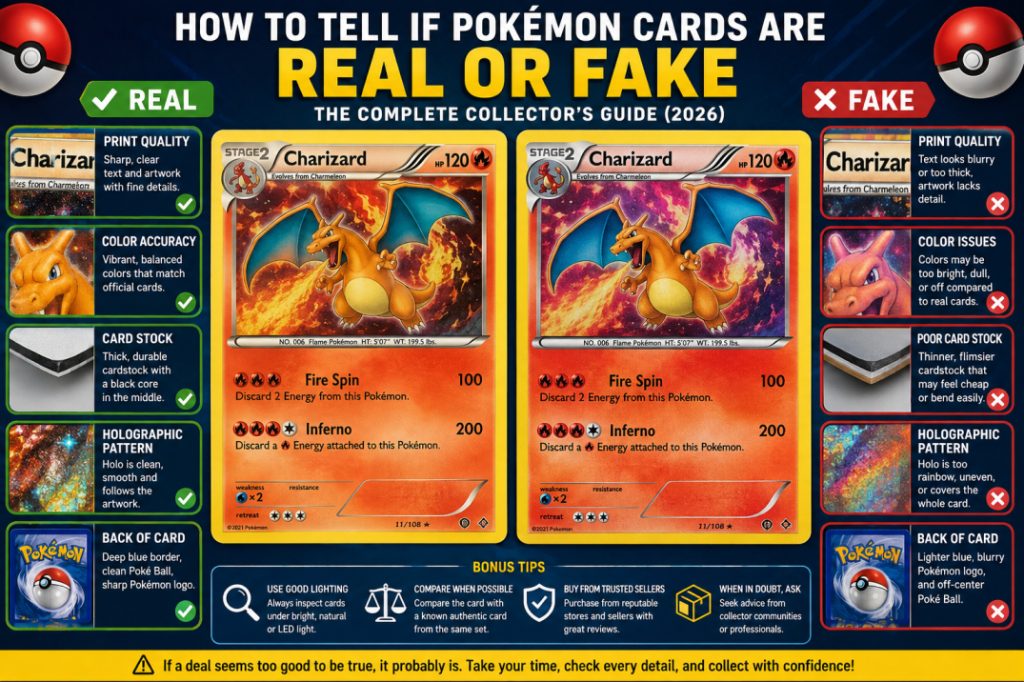
Aug
The Pokémon Trading Card Game (TCG) has never been more popular in the United States. Millions of collectors, competitive players, and investors purchase Pokémon cards every year, hoping to pull valuable chase cards or complete their favorite collections. Unfortunately, the growing popularity of the hobby has also led to an increase in counterfeit products entering the market. From online marketplaces to local swap meets, fake Pokémon cards are being sold to unsuspecting buyers every day.
Learning how to tell if Pokémon cards are real or fake is one of the most valuable skills any collector can develop. Whether you’re purchasing a vintage card from the Wizards of the Coast era, the latest Scarlet & Violet expansion, or an expensive alternate art card, knowing what to look for can protect both your collection and your wallet.
Counterfeit cards have improved over the years, but they still fail to match the quality, precision, and consistency of genuine Pokémon cards. By understanding how authentic cards are manufactured and recognizing the common warning signs of counterfeit products, you can confidently shop online, buy from local sellers, and build a collection that retains its long-term value.
In this complete collector’s guide, you’ll discover the most reliable ways to identify authentic Pokémon cards, understand the techniques counterfeiters use, and learn practical buying tips that help you avoid scams. Whether you’re a beginner or an experienced collector, these authentication methods will help you make informed purchasing decisions in 2026 and beyond.
If you’re just beginning your collection, purchasing factory-sealed Booster Boxes from trusted retailers is one of the safest ways to guarantee that every pack comes directly from an authentic production run.
Why Fake Pokémon Cards Are Everywhere in 2026
The Pokémon card market has experienced tremendous growth over the past several years. Record-breaking auction prices, limited-edition releases, and increased media attention have attracted millions of new collectors. While this growth has benefited the hobby, it has also created opportunities for counterfeit manufacturers.
Many fake cards are produced in factories that imitate genuine Pokémon products using lower-quality materials and inexpensive printing methods. These counterfeit cards are often sold through third-party marketplaces where buyers cannot inspect them before making a purchase.
Scammers know that collectors are often searching for rare cards at discounted prices. They take advantage of this by listing counterfeit cards that appear convincing in photographs but reveal obvious flaws when examined in person.
Common places where counterfeit Pokémon cards are sold include:
- Online auction websites
- Social media marketplaces
- Flea markets
- Swap meets
- Unverified online stores
- Overseas wholesale websites
- Local classified listings
While not every independent seller is dishonest, buyers should always research a seller’s reputation before purchasing valuable cards.
Many experienced collectors prefer sealed Elite Trainer Boxes because they contain official booster packs, accessories, and promotional items distributed through authorized retail channels.
Why Buying Authentic Pokémon Cards Matters
Some collectors assume that a fake card is acceptable if it looks similar to the original. However, counterfeit cards offer none of the benefits that make Pokémon cards valuable.
Authentic Pokémon cards are manufactured according to strict quality standards established by The Pokémon Company. They feature durable card stock, accurate printing, official artwork, and tournament-legal specifications.
Counterfeit cards cannot be authenticated by professional grading companies and generally have no legitimate resale value. Even if a fake card closely resembles the original, experienced collectors and grading experts can usually identify inconsistencies.
Owning genuine cards provides several important advantages:
- Long-term collectible value
- Higher resale potential
- Tournament legality
- Eligibility for professional grading
- Consistent manufacturing quality
- Better durability
- Authentic artwork and finishes
- Greater confidence when buying or selling
Collectors who want specific chase cards often purchase authentic Single Cards from trusted dealers rather than relying entirely on random booster pack openings.
Start with the Overall Print Quality
One of the easiest ways to identify fake Pokémon cards is by examining the overall printing quality.
Official Pokémon cards are produced using commercial-grade printing equipment that delivers crisp text, vibrant colors, and sharp artwork. Counterfeit cards frequently reveal flaws that become obvious during close inspection.
Before looking at fine details, hold the card under good lighting and study the overall appearance.
Examine the Artwork
Authentic Pokémon artwork should appear sharp and highly detailed.
Fine lines remain clear, colors transition smoothly, and backgrounds maintain excellent definition.
Counterfeit cards often display:
- Blurry artwork
- Pixelated images
- Faded backgrounds
- Missing fine details
- Poor color blending
If the artwork immediately looks unusual, compare it with another authentic copy from the same expansion.
Check the Color Accuracy
Pokémon cards use carefully calibrated colors throughout every print run.
While small variations may occur between different production facilities, the differences are generally subtle.
Fake cards commonly display colors that appear:
- Too dark
- Overly bright
- Washed out
- Oversaturated
- Slightly purple
- Yellow-tinted
Comparing two cards side by side often makes these differences much easier to identify.
Inspect the Font Carefully
Fonts are one of the most difficult features for counterfeit manufacturers to reproduce accurately.
Pay close attention to:
- Card name
- HP value
- Attack names
- Attack descriptions
- Weakness and resistance symbols
- Copyright information
- Collector number
On authentic cards, every character appears sharp, evenly spaced, and professionally aligned.
Counterfeit cards often feature:
- Thick lettering
- Thin lettering
- Uneven spacing
- Incorrect font size
- Misspelled words
- Blurry text
Even a slight difference in the lettering can indicate that the card is not genuine.
Feel the Card Stock
Authentic Pokémon cards are made using multiple layers of premium paper bonded together during manufacturing. This layered construction gives the cards their distinctive feel and durability.
Although experienced collectors often recognize genuine cards immediately by touch, beginners can also learn to identify unusual textures with practice.
A genuine Pokémon card should feel:
- Firm
- Smooth
- Slightly rigid
- Consistent in thickness
- Well-balanced
Counterfeit cards frequently feel different because manufacturers use lower-quality paper.
Warning signs include:
- Extremely glossy surfaces
- Thin paper
- Flimsy construction
- Excessive stiffness
- Slippery finish
- Rough edges
The edges of authentic cards should also appear clean and evenly cut without visible fraying.
Compare the Back of the Card
The back of every English-language Pokémon card follows a standardized design that has remained largely unchanged for many years.
Because collectors often focus only on the front of the card, counterfeit manufacturers sometimes overlook important details on the back.
Take a few moments to inspect the following features.
The Blue Border
The blue border surrounding the card should have a rich, consistent color.
Counterfeit versions may appear:
- Too dark
- Too light
- Purple-blue
- Greenish-blue
Color differences become much easier to notice when compared directly with a confirmed authentic card.
The Poké Ball
The Poké Ball in the center should be perfectly printed.
Watch for:
- Uneven circles
- Off-center printing
- Blurry outlines
- Poor shading
- Incorrect proportions
Authentic cards maintain excellent print precision, even under magnification.
The Pokémon Logo
The yellow Pokémon logo should feature clean edges and vibrant colors.
Fake cards often display:
- Blurred outlines
- Incorrect spacing
- Faded yellow coloring
- Jagged lettering
Small inconsistencies in the logo are often enough to raise suspicion.
Check the Surface Texture
Many modern ultra-rare Pokémon cards feature textured surfaces that counterfeit manufacturers struggle to replicate.
Cards such as:
- Full Art Pokémon
- Special Illustration Rares
- Hyper Rares
- Secret Rares
- Alternate Art cards
include carefully engineered texture patterns that are integrated into the artwork itself.
Authentic textured cards produce subtle raised patterns that follow the design of the illustration.
Counterfeit cards frequently have:
- Completely smooth surfaces
- Random embossed bumps
- Printed texture instead of real texture
- Texture that does not match the artwork
Collectors searching for exclusive promotional cards often choose official Collection Boxes, which include genuine promo cards manufactured with the same high standards as booster pack releases.
Inspect the Holographic Pattern
The holographic foil is one of the most recognizable features of many Pokémon cards. It is also one of the hardest elements for counterfeit manufacturers to duplicate accurately.
The Pokémon Company uses several different holographic finishes depending on the rarity and set. These include standard holo, reverse holo, full-art foil, rainbow foil, and textured holographic patterns.
Authentic holo cards produce a clean, balanced reflection when tilted under light. The foil is integrated into the card’s design and enhances the artwork without overpowering it.
Counterfeit cards often show obvious flaws, including:
- Rainbow foil covering the entire card
- Excessive glitter
- Flat reflective surfaces
- Poor alignment
- Foil that looks like a sticker
- Incorrect shine patterns
When comparing two cards side by side, the holographic effect is often one of the quickest ways to spot a fake.
Perform the Light Test
One of the most trusted methods collectors use to determine whether Pokémon cards are real or fake is the light test. Genuine Pokémon cards are made from multiple layers of paper with a dark inner core. This construction blocks most light from passing through while still allowing a small amount to filter evenly.
To perform the test:
- Hold the card in front of a bright flashlight or phone light.
- Compare it with a confirmed authentic Pokémon card from the same era.
- Observe how much light passes through both cards.
A genuine card will allow only a limited amount of light through the paper, while a counterfeit card often lets significantly more light pass because it is made from cheaper, thinner cardstock.
Keep in mind that the light test should never be your only method of authentication. Some high-quality counterfeits can imitate the thickness of genuine cards, so it’s best to combine this test with several others before making a final judgment.
Why You Should Avoid the Rip Test
Years ago, some collectors recommended the “rip test” to determine whether a Pokémon card was authentic. Genuine cards contain a dark center layer, while many counterfeit cards do not. Tearing a card apart would reveal this layer.
Today, this method is strongly discouraged.
If the card turns out to be genuine, you’ve permanently destroyed a collectible that could have significant value. Rare Pokémon cards, especially vintage holos and modern alternate art cards, can be worth hundreds or even thousands of dollars.
Instead, rely on non-destructive inspection methods such as:
- Print quality comparison
- Light test
- Surface texture inspection
- Holographic pattern analysis
- Magnified printing examination
Professional authentication services never use destructive methods when evaluating cards.
Use a UV or Black Light
A UV flashlight can reveal printing inconsistencies that are difficult to see under normal lighting.
While Pokémon cards are not designed to glow dramatically under ultraviolet light, counterfeit cards sometimes use inks or coatings that react differently.
When using a UV light, look for:
- Uneven fluorescent areas
- Unexpected glowing patches
- Strange coating patterns
- Differences compared to a genuine card from the same set
Because manufacturing methods vary slightly between different Pokémon expansions, always compare suspicious cards with an authentic card printed during the same era.
Examine the Card Number and Set Symbol
Every official Pokémon card includes identifying information that helps collectors verify its authenticity.
Near the bottom of the card, you’ll usually find:
- Collector number
- Set size
- Rarity symbol
- Copyright information
- Regulation mark (modern cards)
For example:
045/198
This means the card is number 45 in a set containing 198 cards.
Counterfeit cards often contain:
- Incorrect numbering
- Missing symbols
- Wrong rarity icons
- Misaligned text
- Incorrect copyright years
If you’re unsure whether a card belongs to a particular expansion, compare the numbering with official Pokémon set lists.
Collectors who enjoy importing exclusive releases should also verify the numbering on Japanese Pokémon Cards, as Japanese sets follow different numbering systems than English-language releases.
Check the Copyright Information
One small detail counterfeiters frequently overlook is the copyright text printed at the bottom of the card.
Authentic Pokémon cards include accurate copyright notices for:
- Nintendo
- Creatures Inc.
- GAME FREAK
- Pokémon
- The Pokémon Company International (depending on the release)
Counterfeit cards may include:
- Misspelled company names
- Incorrect years
- Missing copyright text
- Blurry lettering
- Poor alignment
Although this information is small, it often provides one of the clearest signs that a card isn’t genuine.
Inspect the Card Edges
Many collectors forget to examine the edges of a card.
Official Pokémon cards are precision cut using commercial equipment, resulting in:
- Smooth edges
- Uniform thickness
- Clean corners
- Consistent shape
Counterfeit cards sometimes reveal:
- Rough cuts
- Uneven corners
- Fraying paper
- Visible layers
- Jagged edges
Running your finger gently around the card can often reveal manufacturing inconsistencies.
Watch for Deals That Seem Too Good to Be True
One of the biggest warning signs has nothing to do with the card itself.
It’s the price.
If someone offers an expensive Pokémon card for a fraction of its normal market value, you should be cautious.
For example:
- A rare Charizard worth $600 offered for $40.
- A sealed booster box selling for half the current retail price.
- Hundreds of ultra-rare cards bundled together for a surprisingly low price.
While genuine bargains do exist, scammers frequently rely on unrealistic pricing to encourage impulse purchases.
Before buying, compare prices across multiple reputable sellers and check recent market values.
Buy from Trusted Retailers
The easiest way to avoid counterfeit Pokémon cards is to purchase from reputable retailers with a history of selling authentic products.
Authorized stores source their inventory directly from official distributors, reducing the risk of counterfeit products entering the supply chain.
When shopping online, look for sellers that:
- Have strong customer reviews
- Provide clear product photos
- Offer return policies
- Describe product condition accurately
- Respond promptly to customer questions
Factory-sealed Pokémon Tins are another excellent choice for collectors who want authentic packs, exclusive promo cards, and durable storage in one product.
Consider Professionally Graded Cards
If you’re purchasing an expensive collectible, professionally graded cards provide additional confidence.
Professional grading companies inspect cards for authenticity before assigning a condition grade and sealing them inside tamper-evident holders.
Benefits of purchasing Graded Cards include:
- Authentication by experienced experts
- Long-term protection
- Increased buyer confidence
- Easier resale
- Verified condition
Although grading does add cost, it can be worthwhile for high-value cards and investment pieces.
Protect Your Collection After Purchase
Authenticating your cards is only the first step. Proper storage helps preserve their condition and value for years to come.
Essential protection includes:
- Penny sleeves
- Top loaders
- Binder pages
- Deck boxes
- Storage cases
- Humidity-controlled environments
High-quality Pokémon Accessories can help protect your collection from scratches, bending, moisture, and dust while keeping your cards organized.
Final Thoughts
Learning how to tell if Pokémon cards are real or fake is an essential skill for every collector. While counterfeit cards have become more convincing over the years, they still struggle to match the exceptional printing quality, materials, and craftsmanship of genuine Pokémon cards.
By carefully inspecting print quality, colors, fonts, cardstock, texture, holographic patterns, set symbols, and copyright information, you can dramatically reduce your chances of purchasing counterfeit products. Combining several authentication methods provides much greater confidence than relying on a single test alone.
Whether you’re buying individual cards, sealed products, or rare collectibles, always choose trusted sellers and take your time inspecting every purchase. Building a collection of authentic Pokémon cards not only protects your investment but also ensures you’ll enjoy the hobby for years to come.
At PokemonSuppliers.com, we’re committed to helping collectors shop with confidence by offering authentic Pokémon TCG products, expert guidance, and resources designed for beginners and experienced collectors alike.
Frequently Asked Questions
1. How can I tell if a Pokémon card is real or fake?
Check the print quality, font, cardstock, holographic pattern, colors, set number, and copyright information. Comparing the card with a confirmed authentic copy is one of the most reliable methods.
2. Are fake Pokémon cards worth anything?
Generally, no. Counterfeit Pokémon cards have little to no collectible value and cannot be professionally graded or used in official tournaments.
3. Can fake Pokémon cards pass the light test?
Some higher-quality counterfeits may perform similarly, which is why the light test should always be combined with other authentication methods.
4. What is the easiest way to avoid counterfeit Pokémon cards?
Buy from reputable retailers, authorized dealers, or trusted collectors with positive feedback and clear return policies.
5. Can professional grading companies identify fake cards?
Yes. Professional grading companies authenticate cards before grading them and reject counterfeit cards.
6. Are Japanese Pokémon cards harder to counterfeit?
They can still be counterfeited, but authentic Japanese Pokémon cards are known for their exceptional print quality and premium finishes, making flaws easier to spot.
7. Should I buy loose booster packs from strangers?
Exercise caution. Whenever possible, purchase factory-sealed products from trusted sellers to reduce the risk of tampered or counterfeit packs.
8. Why do fake Pokémon cards have different colors?
Counterfeit manufacturers often use lower-quality printing processes that cannot accurately reproduce the colors used on genuine Pokémon cards.
9. Are textured Pokémon cards easier to authenticate?
Yes. Authentic textured cards feature precise embossed patterns that are difficult for counterfeit manufacturers to duplicate accurately.
10. What’s the safest way to start collecting Pokémon cards?
Start with factory-sealed products from reputable retailers, learn the characteristics of authentic cards, and store your collection using quality protective accessories.
